

Volume vs. Weight in Baking: Why you should weigh your ingredients
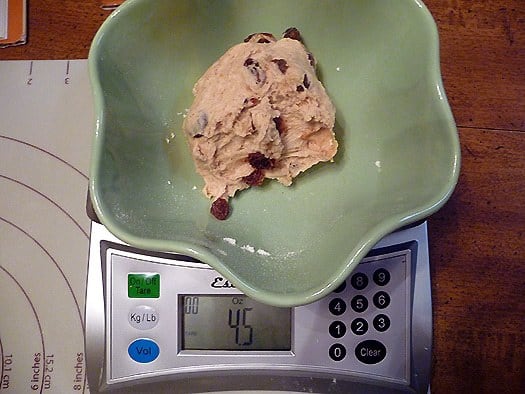
I grew up learning how to measure dry ingredients the way I'm sure just about everyone else did - scoop and level. Scoop the measuring cup into the flour, then take the straight edge of a butter knife and level off the top. Seems easy enough, right? Well, it might be easy but it is certainly not always accurate. For the most part, precise measurements are not necessary in cooking, but are a critical part of baking success. In fact, incorrect measuring is one of the biggest reasons that most baking endeavors fail. A bit of extra flour can lead to rock-hard cookies, tough bread, and less-than fluffy cakes. Too much granulated sugar and your cookies will be crispy when you wanted them soft and chewy. It's been a little over a year since I embraced the joy of measuring by weight, and I just realized that I had never talked about weighing ingredients here on the blog. Continue reading to find out about my little experiment, kitchen scale recommendations, and a list of resources.
The Experiment
A few cookbooks in my collection give ingredient quantities in both volume and weight, but I didn't pay much attention until I made the Thick & Chewy Chocolate Chip Cookies from Baking Illustrated. Curious as to how much of a difference there could actually be between scooping ingredients into measuring cups and weighing them, I conducted an experiment. I measured flour into a cup the way I normally would and then put that scoop on the kitchen scale. Amazingly, there was almost an entire ounce of difference. The scooped flour measured into the cup was almost a full ounce heavier than the recipe stated a cup of all-purpose flour should be. Yikes! That could be a recipe (no pun intended) for disaster. At that point I decided to start weight everything.
Kitchen Scales
The easiest way to get precise measurements of ingredients is to invest in a kitchen scale. There are many on the market and range from inexpensive spring-loaded models to higher-end digital scales. For anyone that bakes on a regular basis, I would recommend a digital scale that measures in both ounces and grams, and that does volume conversions. I personally use an Escali Pana scale (purchased from King Arthur Flour for about $65) that offers ounces, grams, and volume-to-weight conversions that I would highly recommend. However, don't break the bank just to get a scale into your hands. There are many economy models that will do the job just as well. Below is a quick overview of those rated as recommended by Cook's Illustrated (incidentally, they rated my scale Recommended with Reservations because they said the buttons felt cheap):
OXO Food Scale ($49.95)
Polder Easy Read Digital Kitchen Scale ($40.00)
Salter Aquatronic Glass Kitchen Scale ($49.95)
Save This Recipe
Soehnle 65055 Digital Scale ($34.04)
Do you have a scale you use that you would like to recommend? Let us know in the comments section!
Resources
To kick-start your measuring-by-weighing journey, below are some volume-to-weight conversions for common baking ingredients:
♦ All-purpose flour 1 cup = 4.25 ounces
♦ Bread flour 1 cup = 4.5 ounces
♦ Cake flour 1 cup = 4.0 ounces
♦ Sugar (both granulated and brown) 1 cup = 7.0 ounces
For a comprehensive list of ingredients by weight, visit King Arthur Flour's Master Weight Chart.
 Don’t miss a blog post! Subscribe to the Brown Eyed Baker RSS feed!



Hi…I’m confused by the weight in grams in your recipes for Hand Pie dough. It calls for 2.5 cups of AP flour. If one cup of King Arthur flour weighs 120 grams, how is it that the recipe’s 2.5 cups is 354 grams? Which is it…354 grams or 300 grams? Quite a difference!
Thanks!
Hi Deb, For all-purpose flour, I use the measurement that America’s Test Kitchen uses, which is 5 ounces per 1 cup (I’ve also seen this weight used in other cookbooks).
Check out the My Weigh Bakers Percentage Scale Model KD8000. Top rated, has many useful features, easy to read, large capacity and fairly priced. A very popular scale among the baking community. I personally own one.
There is a reason your science teacher made you use a scale instead of a measuring cup when doing experiments in class. Most of the time I don’t think that a little extra flour will make a noticeable difference when baking. However, I always weigh ingredients in cookies. If I don’t I always end up with something a little different than what I expected.
michaelpauljeffus@gmail.com
ytytsong@gmail.com
g6zionchapel@googlemail.com
I have just recently converted my first cupcake recipe to weight. The reason was to hopefully be note accurate, also so I could break it down into a single cupcake recipe. I want to test flavor additions, so just 1 is better than wasting a batch of 30 ……. Place I like to use for conversion is……..http://www.traditionaloven.com/ conversions for anything.
I am finding it very time consuming to convert recipes from volume to weight. Might be a factor of my age. I also have found different reputable sites showing different weights for the same item. I cannot afford to make mistakes….I don’t have the scale that automatically converts the volume to weight or vice versa and cannot afford it either. I seem to remember reading that you were going to be posting your recipes with both weight and volume. I am very anxious to be able to bake with weight. When will this happen? Will you be posting new recipes with weight measurements along with volume? And hopefully you will convert your older recipes to weight. I am making many of your recipes. Probably in the last year I have made 15 of your recipes. I think I would have had better outcomes if I could have known what weight you have actually used in your recipes, Thanks for wonderful recipes
I am a convert to using a scale! I love it! I actually have a cheat sheet of weights (in grams and oz.) taped to the container that holds my bags brown sugar, powdered sugar, etc. I find it so much easier to cut a recipe in half using the weight in grams – and know that if 1 cup of sugar is 200g then ¾ c is 150g, etc. Keeps you on your toes with math! I use the weight of 5oz for flour (from ATK) because I don’t use KAF. When using a scale, I like not having to dirty measuring spoons when adding ingredients such as mustard or mayo to a recipe, just “tare” or zero out the scale and squeeze in 5 g of mustard, etc. I use my scale for so many things every day. Sounds crazy, but I weigh the almonds and pistachios that go into my kids lunch, I weigh the chips. No guessing on how big a handful if it’s too early in the morning when packing lunch. I even weigh the chicken as I’m putting it on the sandwich to make sure I use enough. I weigh the ingredients while making my morning green smoothie to take out the guess work and make a consistent smoothie every day. A day does not go by without using my scale!