

Basic Pâte à Choux Recipe

I’m sharing all my tips for making light as air pâte à choux. This delicate pastry makes airy pastry perfect for filling with sweet and savory stuffings. Learn everything you need to know about choux pastry from how to make, pipe, store, and fix some of the most common issues.
The Background
If you are not familiar with choux pastry, it’s a light and airy dough used to make desserts ranging from eclairs to churros and more. This unique dough is twice-baked, first on the stove, to create a silky smooth finish. Then it bakes to golden perfection in the oven.
Made with water, eggs, flour, and butter the pastry has a high moisture content which causes the pastry to rise and leave space for delicious fillings to be stuffed with pastry cream or other fun fillings. Once you’ve mastered making choux pastry, the delicious treats you can make are endless including:
- Eclairs: Pastry cream is piped into long logs and then filled with pastry cream and topped with chocolate.
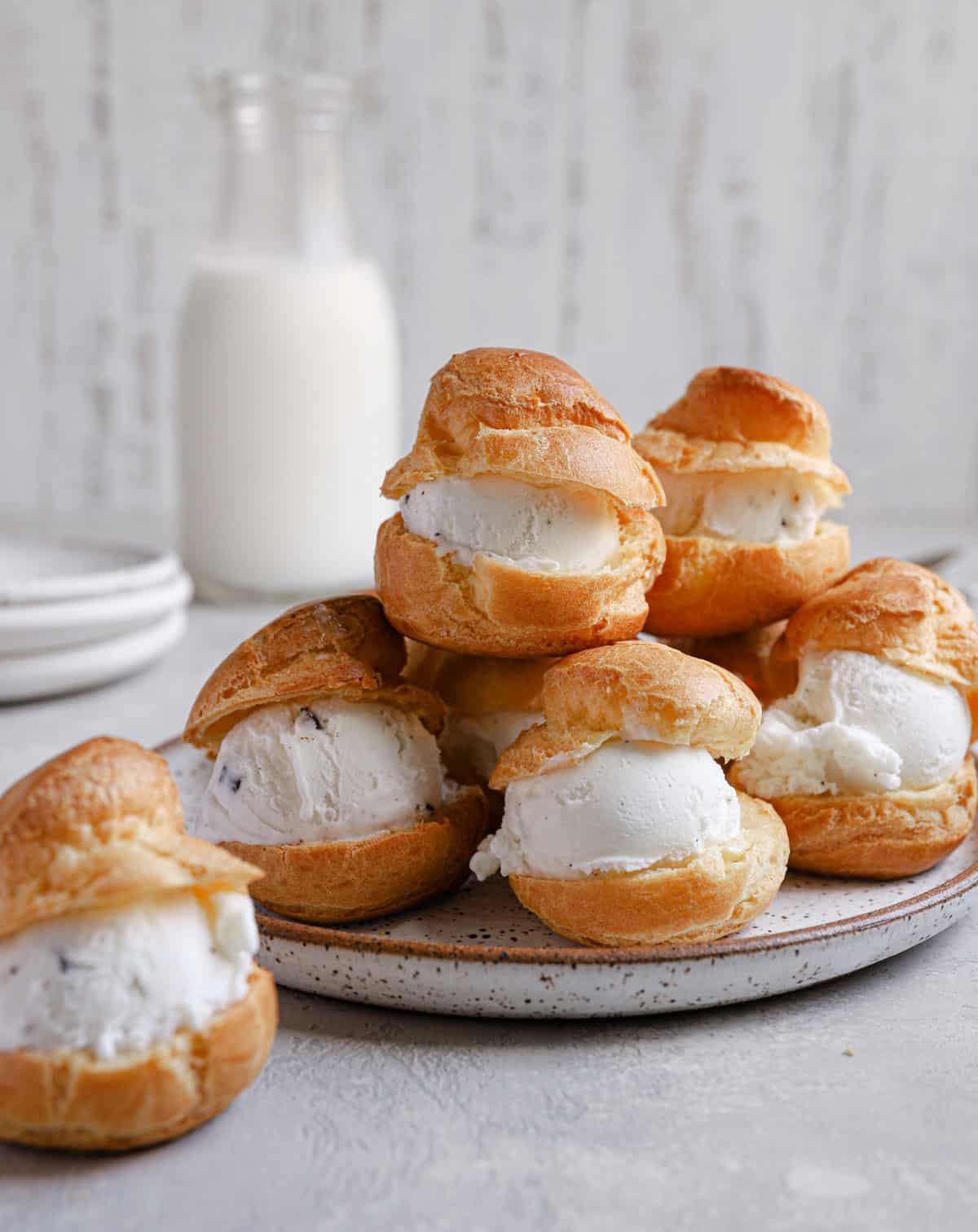
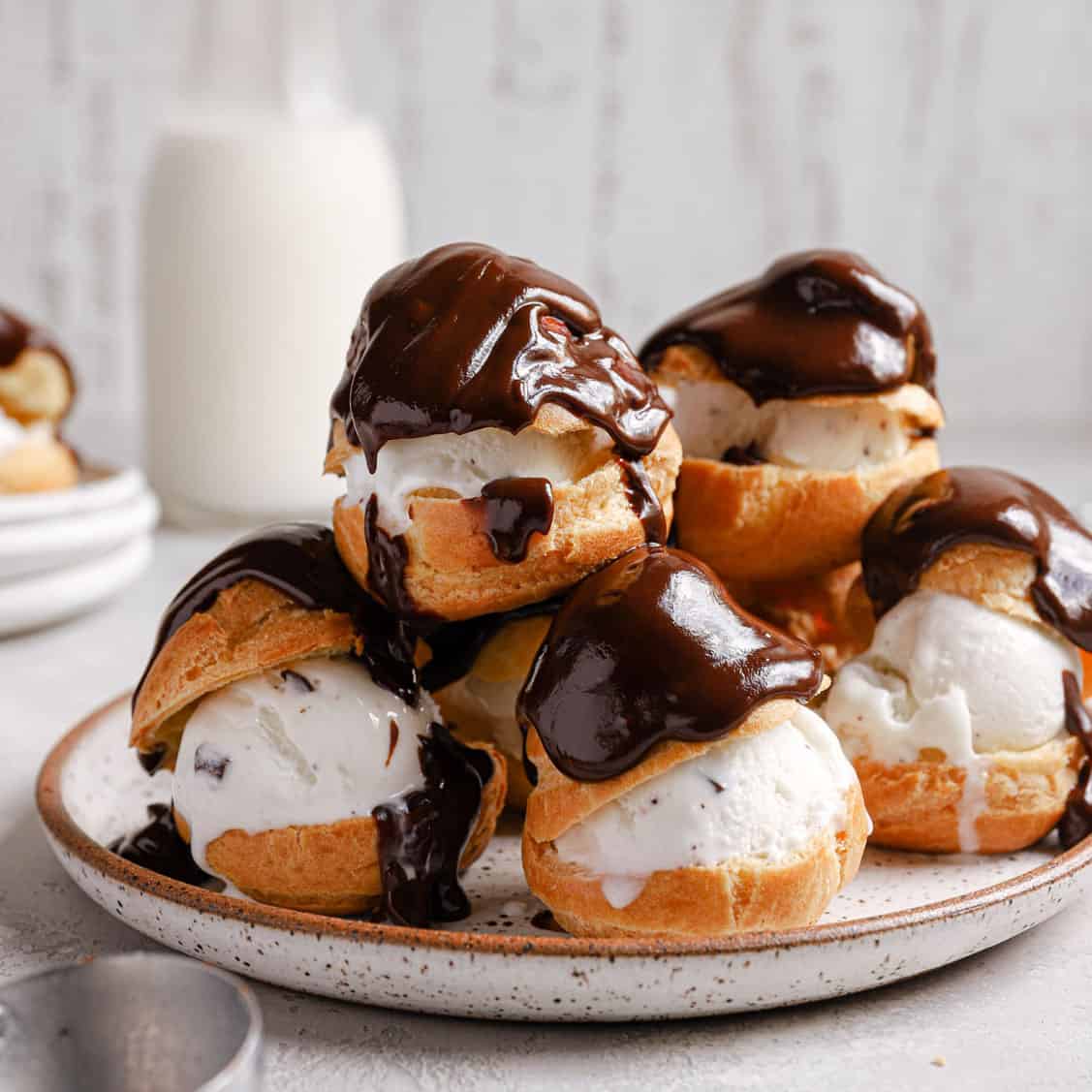
- Profiteroles: Also known as cream puffs, profiteroles are filled with pastry cream or ice cream. They often come served with a silky chocolate topping.
- Croquembouches: A cone-shaped tower made from choux pastry puffs baked and dipped in caramel binding the tower together.
- Gougeres: A savory appetizer made with choux pastry.
- Beignets: The dough is fried instead of baked into a type of fritter.
- Churros: Piped from a star-shaped nozzle and fried into a crispy treat.
Ingredients
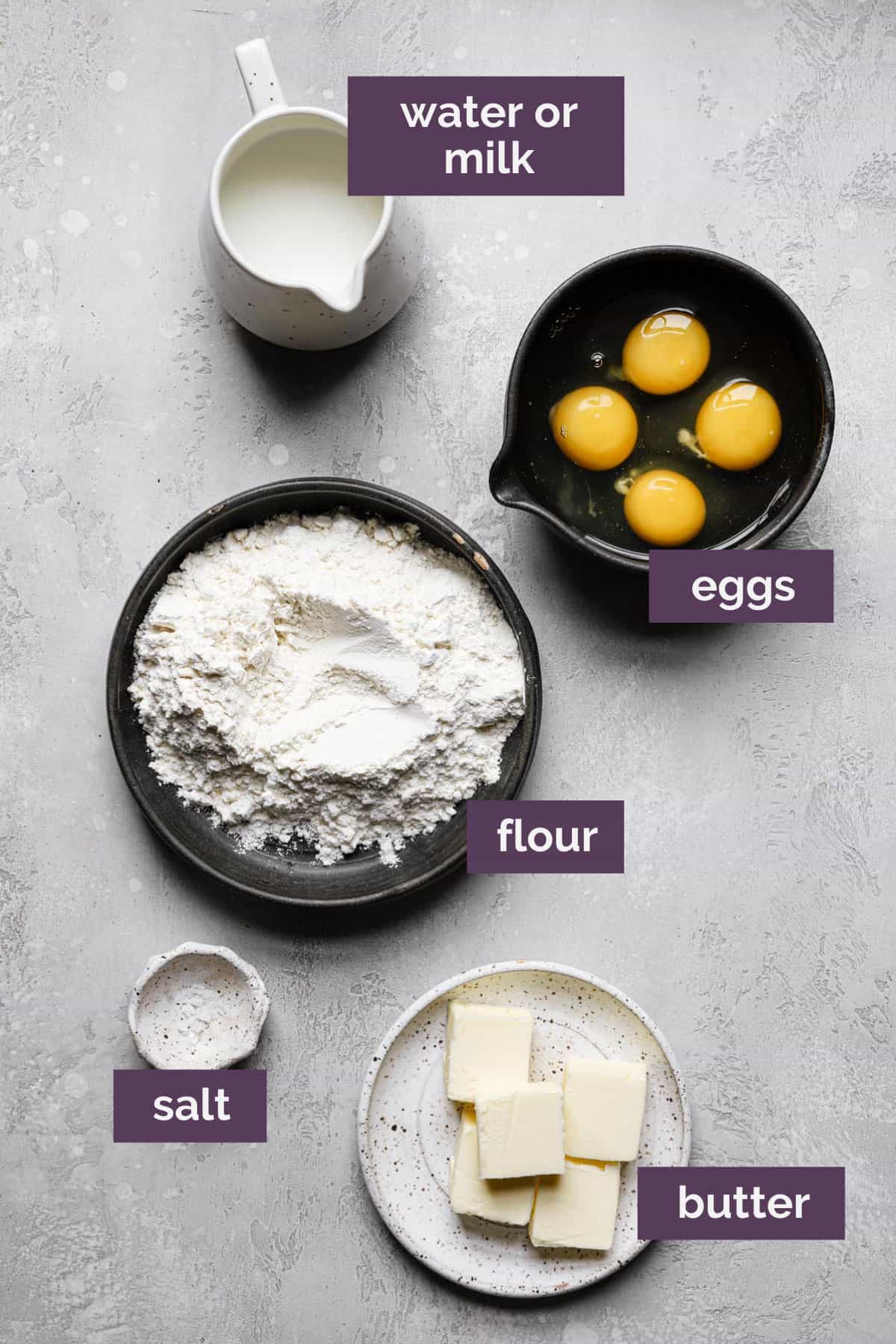
The beautiful thing about this dough is that it uses just a handful of pantry staple ingredients that you probably already have on hand.
- Milk: You can also use water or a combination of both water and milk. Depending on the final pastry you are making with the dough, one or the other may be called for in the recipe.
- Butter: During the baking process, this allows the pastry to rise.
- Salt: Gives a little flavor to the choux.
- Flour: Gives structure to the pastry.
- Eggs: Helps give the pastry structure and makes a crisp outer shell.
Step-by-Step Directions
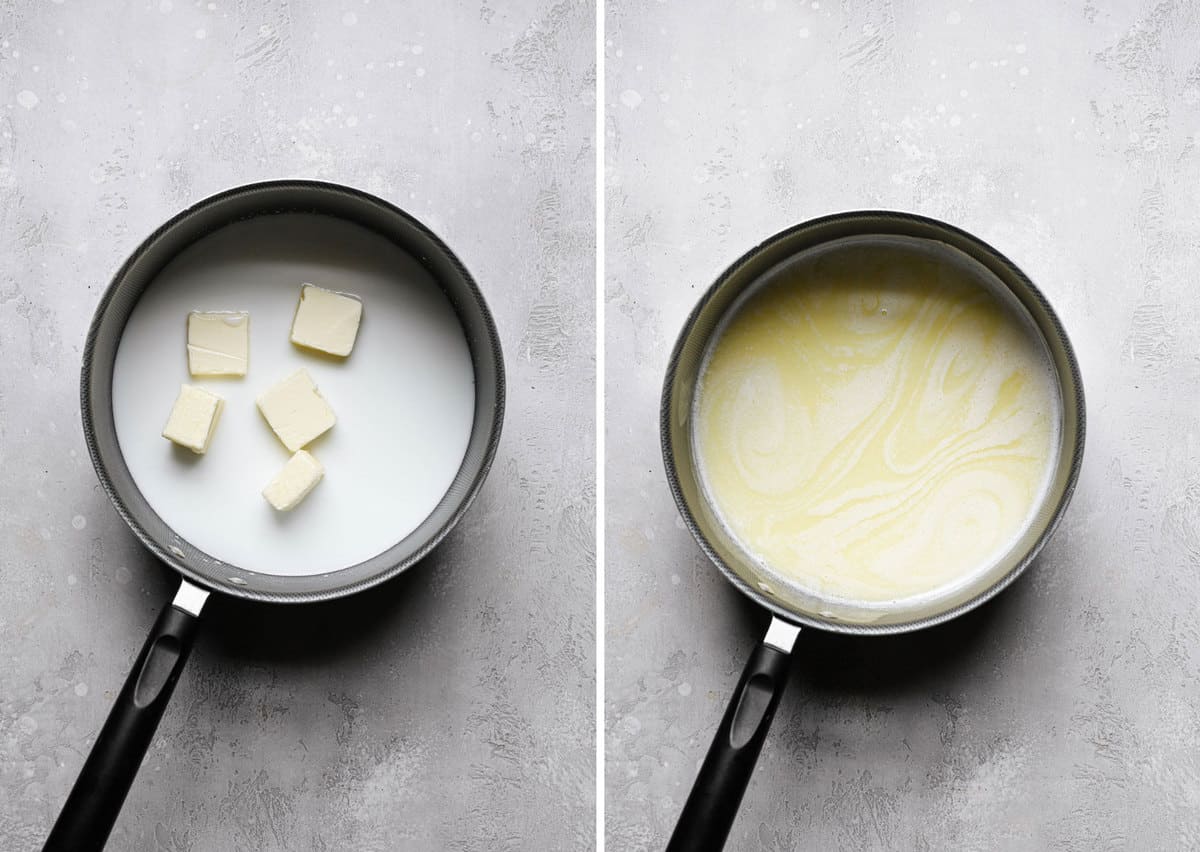
- Boil milk, butter, and salt: Place the water or milk, butter, and salt in a medium saucepan. Place over high heat and bring to a full rolling boil.
- Add the flour: Remove from the heat and add the flour all at once. Using a wooden spoon or a stiff silicone spatula, stir until the flour is thoroughly mixed in and no clumps remain, pressing and smashing the dough against the sides of the pan.
- Stir the dough together: Return the pot to medium-high heat and cook, stirring frequently until the dough comes together in one mass and there is a dry film on the bottom and sides of the pan.

- Check the temperature: If you have an instant-read thermometer the temperature of the dough should register at 175°F.
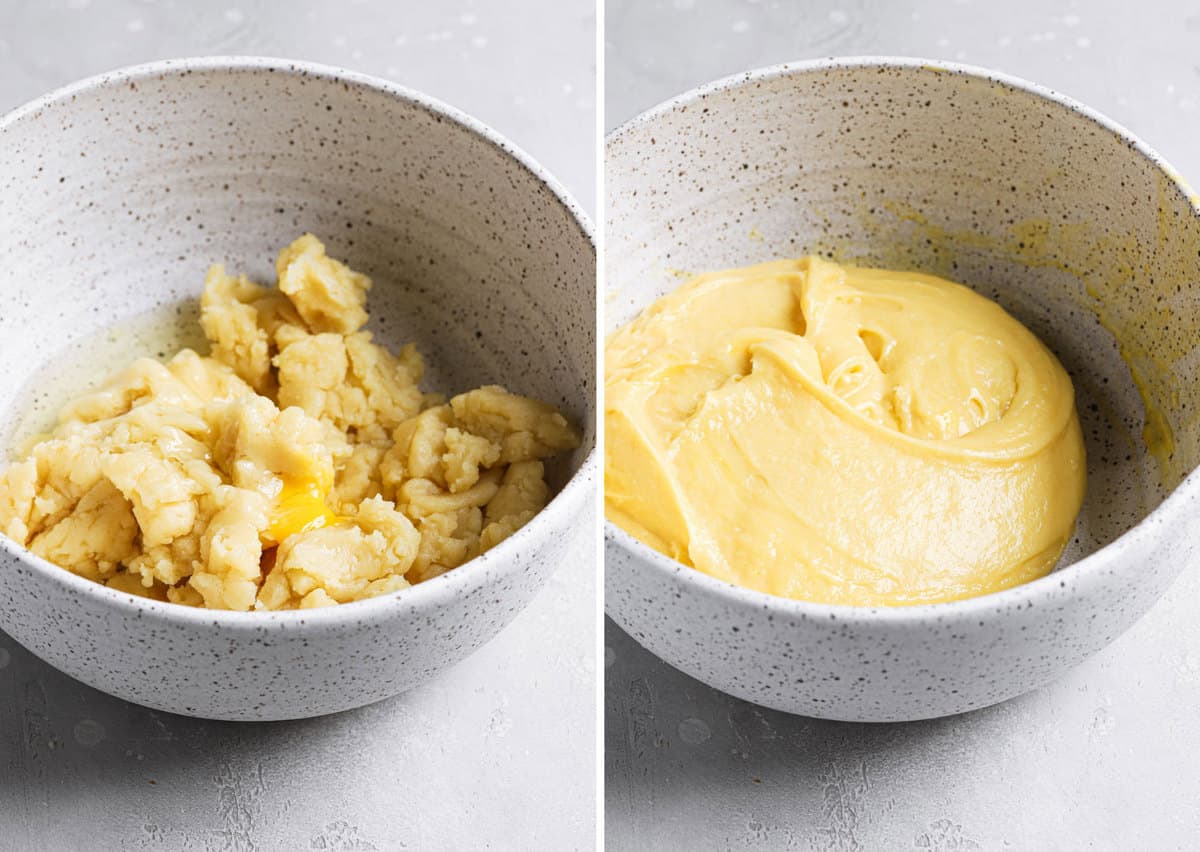
- Beat in a mixer: Transfer the dough to a mixing bowl and beat on medium speed for about 2 minutes to cool the dough down. Check the temperature again, it should read about 145°F.
- Mix in eggs: Add the eggs one at a time, ensuring each one is fully incorporated before adding the next. Once all of the eggs have been added scrape down the bottom and sides of the bowl and mix again to ensure everything is fully incorporated for an additional 5 to 10 seconds.
Piping the Dough
Once you’ve made the dough, you will then need to determine what shape pastry you plan to make. I’ll give you directions for piping some of the most common choux pastry shapes.
-
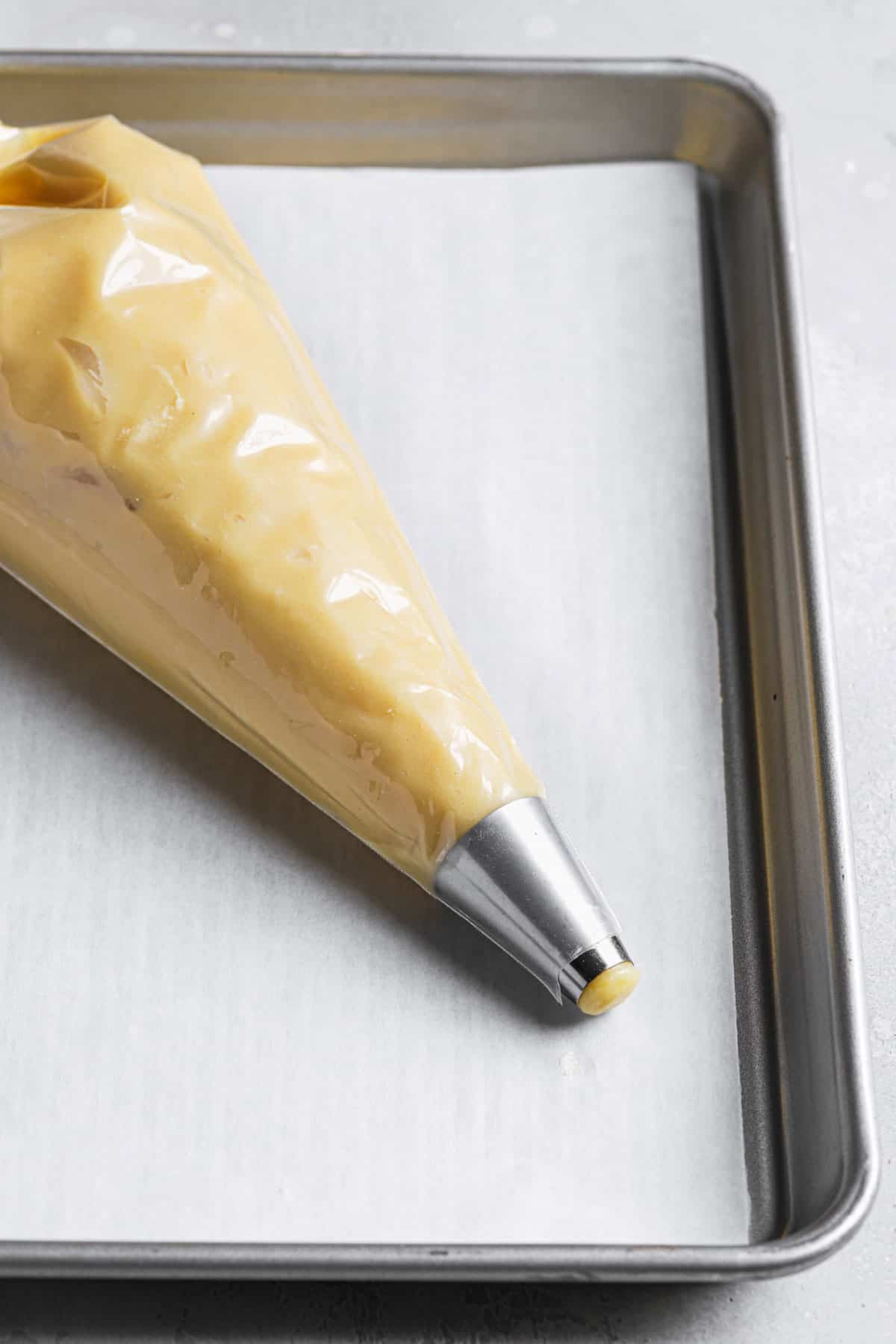
Round (for puffs)– Use a round 1/2-inch piping tip. Make sure the tip always touches the dough to prevent ripples. Hold the bag upright as you pipe the dough to ensure the pastry will rise upwards.
-
Elongated (for eclairs)– Use a round or French star tip pipe the dough out at a 45° angle and keep consistent pressure while you pipe.
After piping the rounds and eclairs, be sure to dip your finger in water and flatten any points that might have been made with the pastry tip to prevent spots from burning.
Baking
After piping your pastry onto parchment paper, you are ready to bake these beauties!
Save This Recipe
Depending on the different pastry you plan to make your baking instructions will change.
Filling Options
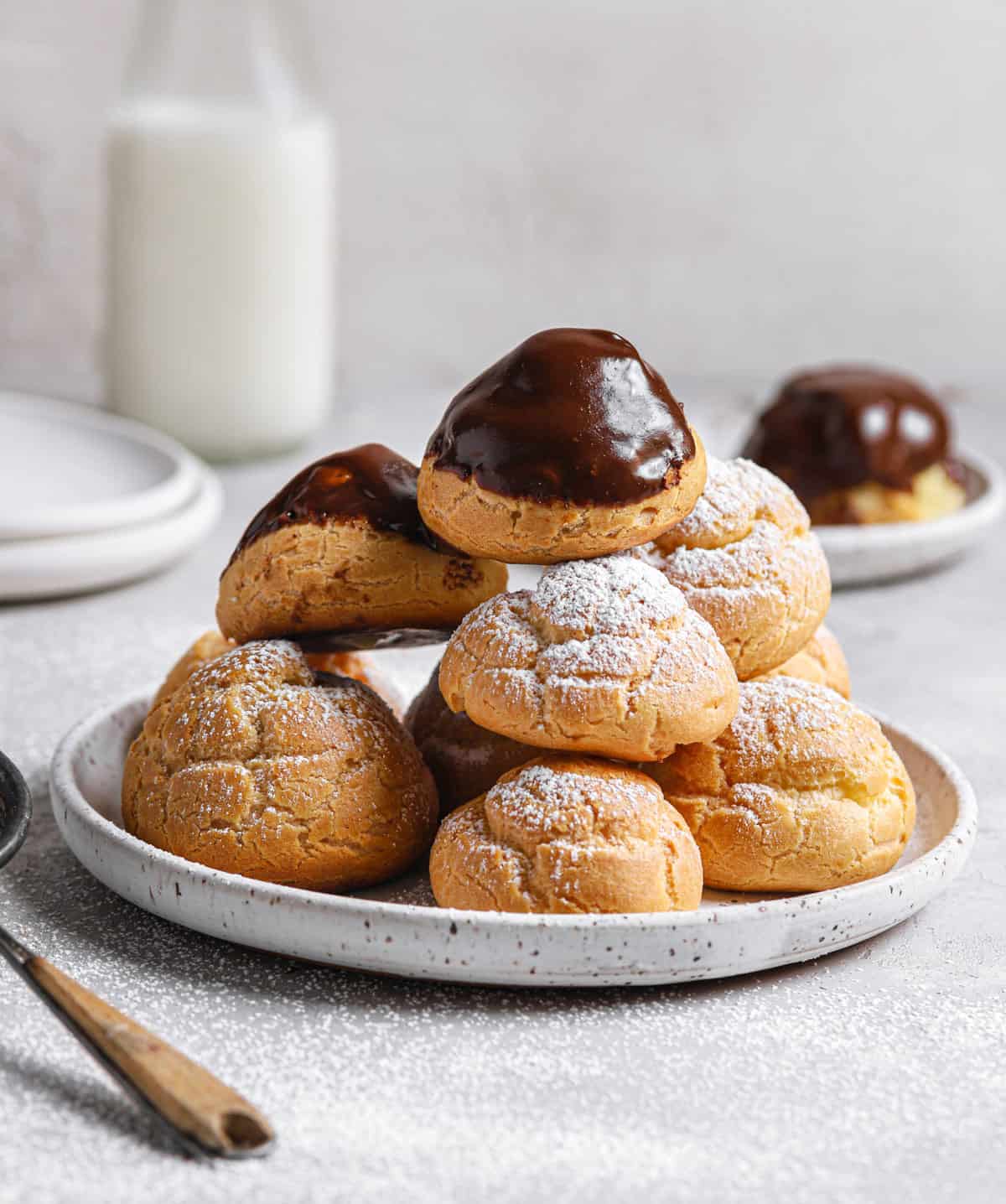
Now, this is where you can really get creative with choux pastry. Since the dough is rather bland in flavor, you can really dress it up by stuffing it with many different fillings. Some of my favorite ways to fill baked pâte à choux include:
- Pastry cream
- Lemon curd
- Ice cream
- Homemade whipped cream
FAQ and Troubleshooting
Some of the most common issues surrounding choux pastry include runny dough and collapsed pastries. Let’s talk a little bit about why these issues occur, how you can prevent them, and ways to fix the issue if they happen.
Collapsed Pastry
There are two main reasons your pastry will collapse. The first is that the oven was opened before the choux cooked through. This happens when you open the oven to check on them before the cooking time is complete. I would suggest keeping the door closed the first 20 minutes of baking before peeking for a doneness check.
By opening the oven you allow the steam to escape preventing the exterior of the pastry from crisping up.
Choux pastry also collapses when you do not prick the baked pastry shells to vent the hot air from inside. If un-vented, the hot air adds moisture inside the pastry and causes it to collapse while cooling.
Making in Advance
- Store unfilled baked pastry shells in an airtight container for up to 2 days. Reheat them in the oven to crisp up and fill.
- Freeze baked pastry shells in an airtight container for up to 3 months, thaw, and bake to crisp up before filling.
What to Make with Pâte à Choux
Take on the art of making choux pastry at home with this in-depth guide. From making the dough to troubleshooting the biggest issues, this guide has you covered for all your pâte à choux needs!
Watch the Recipe Video Below:
If you make this recipe and love it, remember to stop back and give it a 5-star rating - it helps others find the recipe! ❤️️

Pate a Choux Recipe
Ingredients
- 1 cup (240 ml) milk or water, or combination
- 6 tablespoons (85 g) unsalted butter, cut into ½-inch cubes
- ½ teaspoon (0.5 teaspoon) kosher salt
- 1 cup (120 g) all-purpose flour, sifted
- 4 eggs
Instructions
- Place the water or milk, butter, and salt in a medium saucepan. Place over high heat and bring to a full rolling boil.
- Remove from the heat and add the flour all at once. Using a wooden spoon or stiff silicone spatula and stir until the flour is thoroughly mixed in and no lumps remain, pressing and smashing the dough against the sides of the pan.
- Return the pot to medium-high heat and cook, stirring frequently, until the dough comes together into one mass and there is a dry film on the bottom and sides of the pan. If you have an instant-read thermometer, it should register 175 degrees F.
- Transfer the dough to a mixing bowl and beat on medium speed for about 2 minutes to cool the dough down. It should register 145 degrees on an instant-read thermometer.
- Add the eggs one at a time, ensuring each one is fully incorporated before adding the next. Once all of the eggs have been added, scrape down the bottom and sides of the bowl and mix again to ensure everything is fully incorporated, an additional 5 to 10 seconds.
- Use immediately or keep at room temperature for up to 2 hours in a piping bag or with a piece of plastic wrap pressed against the surface.
Notes
- Make the Dough By Hand: You do not need a mixer to make this dough; I often make it by hand. Cool it down by stirring it frequently with a spoon or spatula, then beat in each egg one at a time by hand.
Did you make this recipe?
Leave a review below, then snap a picture and tag @thebrowneyedbaker on Instagram so I can see it!
Photography by Dee Frances



This is a useful point about editing images with both prompts and reference visuals. For readers comparing creative workflows, this image tool is a relevant reference for upload, prompt, preview, and export steps.
Great context. For AI-assisted visuals, ChatGPT Images 2.0 has been reliable for both photorealistic and stylized outputs.
I recently got feedback from an FPS player who said the cm/360 converter was useful, but they wanted a way to save their mouse DPI and in-game sensitivity instead of re-entering the same values every time they switched games.
So I added saved sensitivity profiles to ZeroedTools.
The idea is simple: FPS players often move between Valorant, CS2, Apex Legends, Call of Duty, Overwatch 2, PUBG, Fortnite, Rainbow Six Siege, The Finals, and Delta Force. A sensitivity converter is useful, but it becomes much better when your common setup can be reused.
ZeroedTools now lets players save their DPI and game sensitivity profile, then use it again when converting between games or checking cm/360 and eDPI values.
I’m still improving the toolkit, so I’d love feedback from anyone who plays FPS games or has built gaming tools before.
Link:
https://dfaccount.com/en/
[test marker 20260729-055901 #10]
I recently got feedback from an FPS player who said the cm/360 converter was useful, but they wanted a way to save their mouse DPI and in-game sensitivity instead of re-entering the same values every time they switched games.
So I added saved sensitivity profiles to ZeroedTools.
The idea is simple: FPS players often move between Valorant, CS2, Apex Legends, Call of Duty, Overwatch 2, PUBG, Fortnite, Rainbow Six Siege, The Finals, and Delta Force. A sensitivity converter is useful, but it becomes much better when your common setup can be reused.
ZeroedTools now lets players save their DPI and game sensitivity profile, then use it again when converting between games or checking cm/360 and eDPI values.
I’m still improving the toolkit, so I’d love feedback from anyone who plays FPS games or has built gaming tools before.
Link:
https://dfaccount.com/en/
[test marker 20260729-055106 #10]
This guide on pâte à choux is incredibly thorough, especially the troubleshooting section on collapsed pastries. It’s helpful to understand that opening the oven too early or not venting the shells can cause them to collapse.
https://lovimg.com/
I recently got feedback from an FPS player who said the cm/360 converter was useful, but they wanted a way to save their mouse DPI and in-game sensitivity instead of re-entering the same values every time they switched games.
So I added saved sensitivity profiles to ZeroedTools.
The idea is simple: FPS players often move between Valorant, CS2, Apex Legends, Call of Duty, Overwatch 2, PUBG, Fortnite, Rainbow Six Siege, The Finals, and Delta Force. A sensitivity converter is useful, but it becomes much better when your common setup can be reused.
ZeroedTools now lets players save their DPI and game sensitivity profile, then use it again when converting between games or checking cm/360 and eDPI values.
I’m still improving the toolkit, so I’d love feedback from anyone who plays FPS games or has built gaming tools before.
Link:
https://dfaccount.com/en/
Getting the moisture ratio right during the stove-to-oven transition is always the trickiest part of choux, especially since adding the flour all at once requires such rapid mixing. I’ve found that mapping out a visual companion of the dough’s texture at each stage—like the film on the saucepan—helps prevent flat pastries. I actually mapped these critical ingredient stages using Flowgraph to keep as a handy cheat sheet on my kitchen cabinet.
The tip about under-working the dough until it pulls away cleanly from the pan sides really made everything click for me — I’ve been overmixing and ending up with dense puffs for months. One small follow-up: do you find the humidity in your kitchen affects how the dough behaves on particularly muggy days? I’ve noticed my lamination seems off in summer even with the same measurements. I sometimes watch baking tutorials on my tablet while I work, and being able to pull videos from Instagram or TikTok with Muka Saver App makes it easy to reference technique clips without hunting for my phone.
I never realized that pâte à choux is actually twice-baked, starting on the stove before heading into the oven. Understanding that the high moisture content is what creates that perfect hollow center for pastry cream makes the whole process seem a lot less intimidating. I’m definitely going to use these tips to try making my own eclairs this weekend!
I appreciate how this recipe covers fixing common issues—it’s as thorough as the crop calculator I use on Grow a Garden 2 Wiki.
One detail I always come back to with choux is how much the shape and spacing affect the final result—getting the right gap between piped puffs is surprisingly important for even rising. While the recipe emphasizes precise piping, the spatial awareness needed to judge those gaps without overlapping is similar to the logic behind nailing the ⬜cat placement⬜ in a sudoku-style puzzle, where you’re visualizing separation without physically moving pieces.
When pâte à choux puffs come out lopsided or deflate, it’s often a sign the dough wasn’t cooked long enough on the stove to evaporate excess moisture before baking. Getting that initial panade to form a thin film on the bottom of the saucepan is the exact moment where technique makes or breaks the final puff. If you’re filming step-by-step execution of that precise window for a video series, an AI consistent character generator would help maintain the same host face across multiple takes without requiring a full reshoot.
The part about pressing and smashing the dough against the pan to form the dry film is easy to gloss over, but that step is the difference between a puffy choux and a flat disk. Getting that moisture ratio right during the stovetop bake has less to do with your stirring technique than it does with forcing the starch to fully gelatinize. Once you nail that foundation, the creativity with fillings and shapes is the fun part, and it helps to have a tool like a consistent character ai to keep the visual side of a baking series just as steady as the dough.
Choux pastry can be so tricky to get right, but your tips make it seem much less intimidating! I usually struggle with scaling the measurements, so I used this handy recipe scaler to adjust the batch size, and it worked out perfectly. Can’t wait to bake these!
Great tutorial! I’ve been saving my favorite baking recipes with https://glypho.app and this pâte à choux recipe is definitely going in my collection. Thanks for the detailed steps!
This is a well-written article.
https://www.wiremeshsourcing.com/
Merci pour cet article complet sur la pâte à choux ! Vos astuces pour une texture légère et les solutions aux problèmes courants sont très utiles. J’ai hâte d’essayer.
anime image upscaler
What a fantastic, comprehensive guide to pâte à choux! I’ve been baking for years but always struggled with choux pastry – my eclairs would either collapse or come out dense and heavy, and I could never figure out why. Your explanation of the science behind each step, especially the importance of cooking out the moisture and drying the dough until that thin film forms on the bottom of the pan, was exactly what I needed to hear. It’s like you read my mind about all the mistakes I’ve been making!
I tried this recipe yesterday and honestly, it was the first time my choux puffs actually came out light and airy with that perfect hollow center. I filled them with vanilla pastry cream and they were gone within an hour – my husband couldn’t stop raving about them. The step-by-step photos made all the difference too; being able to see what the dough should look like at each stage took so much of the guesswork out.
Quick question for you – have you ever experimented with savory choux? I’d love to try making gougères with cheese and herbs, but I’m not sure if the baking times or technique would be different from the sweet version. Any tips would be much appreciated!
Also, I wanted to share something that’s been helping me lately. I’ve been using this tool called InterviewFox to practice for job interviews – I’m looking to transition into a pastry chef role at a nicer restaurant, and it’s been a game-changer for preparing for the behavioral and technical questions they ask. It’s nice to find tools that actually help you grow professionally, you know?
Anyway, thank you so much for this recipe and all the detailed explanations. I can’t wait to try making eclairs next – your troubleshooting section on collapsed pastry was especially helpful. Keep up the amazing work!
~ Sarah from Portland
If you’re into baking and love making pastries from scratch, you have to check out this incredibly detailed guide on making pâte à choux. It walks you through everything from ingredients to piping techniques, helping you create light, airy eclairs, cream puffs, and more. And if you’re looking to save or download beautiful food photos or videos from Instagram for inspiration, you can use a handy tool like DownReels to grab any public Instagram content directly in your browser. Perfect for keeping those recipe visuals handy!
Really well written, the logic flows naturally and every detail feels thoughtful. Took my time reading through and totally get the ideas you shared here.Edit Text
This pâte à choux guide is genuinely one of the clearest, most reliable resources I’ve found—especially for beginners tackling eclairs or cream puffs for the first time. Michelle breaks down every step with precision, from that critical dough temperature check to troubleshooting hollows or deflation. If you love baking but want to level up your pastry game *without* the overwhelm, this recipe is gold. And if pixel-perfect food art inspires your next baking project—or you just want to visualize your choux creations before piping—try turning your ideas into Minecraft-style pixel art in seconds:
PixCraft.space
The emphasis on cooking out the moisture in the saucepan before adding the eggs is absolutely key. I remember my first few attempts at choux pastry, and they always resulted in flat, dense little blobs because I didn’t realize how critical that step was. Your explanation of *why* it’s important, that it prevents the eggs from scrambling and allows the steam to create that signature puff, is really helpful for someone like me who learns best with a bit of science behind it. I’ve been experimenting with different pastry doughs lately, and I even wrote about a similar approach on EZ Reels and found that understanding the underlying principles makes a huge difference in the final outcome. Thanks for breaking it down so clearly!
The detail about cooking out the moisture in the saucepan before adding the eggs is such a crucial step, and it’s great that you’ve emphasized it. I used to struggle with getting my choux pastry to rise properly, and it was exactly that step I was rushing. It’s like with any precise process, whether it’s baking or analyzing financial data; overlooking a foundational element can really throw off the end result. I’ve been exploring how AI can help streamline some of these complex analyses, and I even wrote about a similar approach on BestCryptoByAI and found that understanding the core mechanism is key to successful prediction. This recipe feels like that for pastry – mastering the basics unlocks so much potential!
I always appreciate recipes that explain the “why” behind the steps, and your explanation of cooking out the moisture in the saucepan really clarifies the process for pâte à choux. It reminds me a bit of how crucial it is to get the moisture content just right when preparing product images for platforms like Amazon – too much or too little can cause issues. I’ve been experimenting with different pastry doughs lately, and this detailed guide makes me feel much more confident about tackling choux. I’m particularly interested in your tips for fixing common issues; that’s often where the real learning happens!
The way you broke down the “why” behind each step, especially about cooking out the moisture in the saucepan, really clicked for me. It’s like when you’re prepping a product image for Amazon – you have to get the foundation *just right* before you can build on it, otherwise, the whole thing falls apart. I was actually just looking at this tool called Amazon Listing AI the other day; it helps you check those foundational image requirements to avoid rejections. It made me think of how crucial these basic techniques are, whether you’re baking or selling online.
I’ve always been intimidated by pâte à choux, but your step-by-step photos make it look surprisingly doable—can’t wait to try the cream puff variation. By the way, as a fellow home baker who also enjoys the occasional lottery game, I recently found a handy tool that reads ticket numbers from a photo, so I don’t have to type them in manually. It’s a small time-saver when I’m testing numbers after a bake. Do you ever play while waiting for dough to rest?
I tried this recipe over the weekend and was honestly shocked at how easy the dough came together after the flour was mixed in—I always thought choux was way more
unc test
I’ve always been intimidated by choux pastry, but your tip about cooking the flour long enough until a film forms on the bottom of the pan was the game-changer I needed. I tried the profiteroles with vanilla ice cream like in your photo, and they actually puffed up perfectly—no deflating this time!
unc test
I’ve always been intimidated by choux pastry, so I really appreciated how you broke down the stove-top cooking step—I never realized you had to dry the dough until it forms that thin film on the bottom of the pan. I tried your tip about letting the eggs come to room temp before adding them, and my batter actually held its shape when I piped it for the first time. Thanks for making this feel doable!
unc test
The detail about cooking the flour out of the dough after adding the eggs is crucial for preventing a gummy texture. It’s something I learned the hard way when first experimenting with choux pastry. I always emphasize that step in my own guides, and it’s great to see it highlighted here so clearly. It reminds me of the precision needed in strategy games as well; even a small oversight can lead to a completely different outcome. I wrote about a similar approach to mastering complex game mechanics on FrontWars.io and found that understanding the “why” behind each step is key to success.