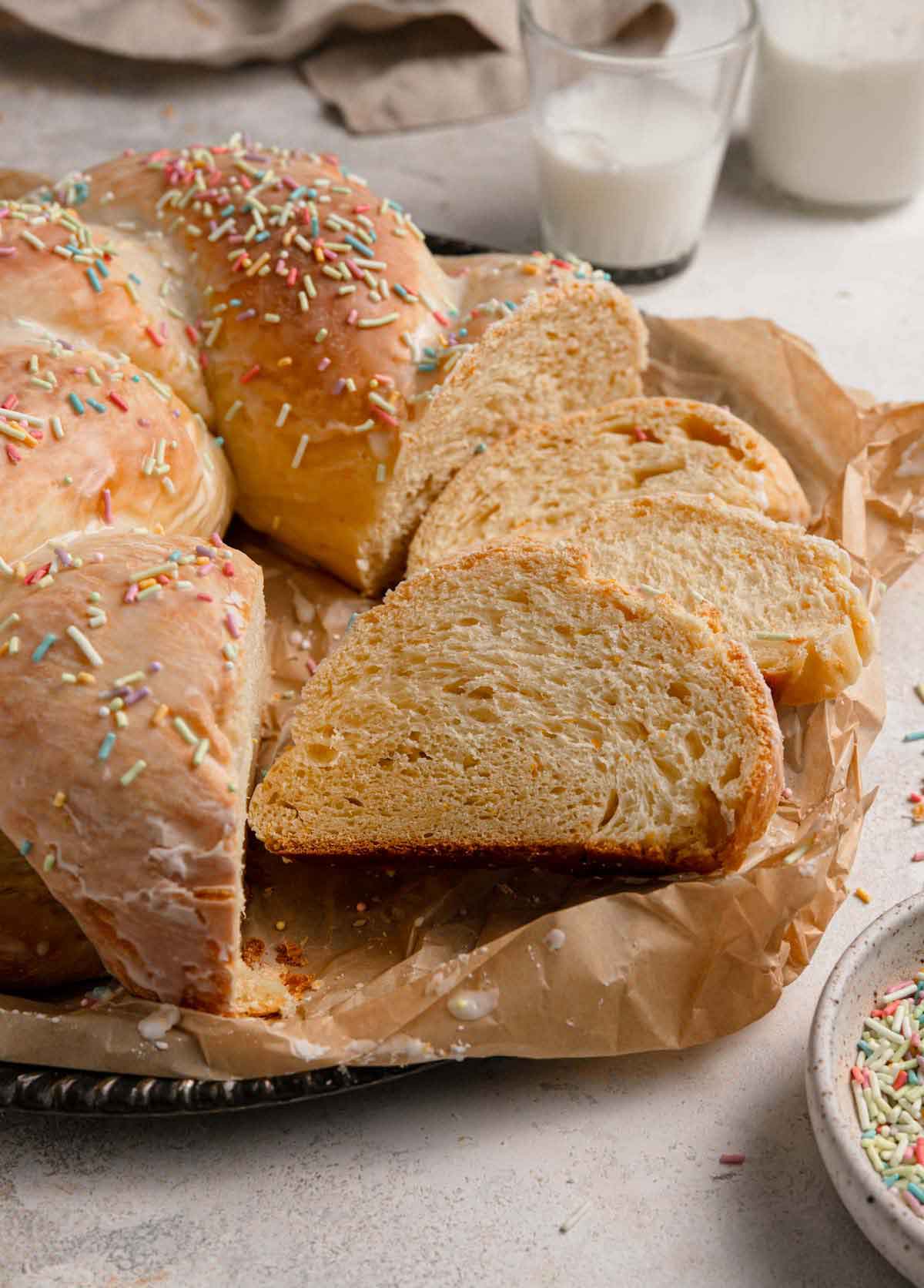

Italian Easter Bread
I like to think that I am usually pretty “with it” when it comes to Italian food traditions, having come from an Italian family with a grandma who lived to cook and bake. She had so many holiday traditions, but when my Chief Culinary Consultant’s dad started talking about his Nana’s Easter bread, with orange and anise, I was befuddled. This traditional Italian bread and I had never crossed paths. It seemed inconceivable that my grandma hadn’t ever made it, but I definitely had never eaten it. There was no question that I needed to get my fill of Italian Easter Bread, immediately. Not 24 hours after we pulled back into Pittsburgh last week, my CCC’s dad touched down for a long weekend to visit with some family. On his agenda for the weekend was making his Nana’s Easter bread recipe. I was excited to finally try some of this bread, and learn more about the recipe. First of all, and most importantly, the bread is fabulous. I may have eaten close to a loaf all on my own. It’s a rich, sweet bread – much like a brioche – and is flavored with orange and anise. He was generous enough to share with me his family’s recipe so that I could make it on my own and share it with all of you. Precisely one day after he left, I covered my kitchen in flour and cranked out some loaves of my own. They turned out amazing, and I’m sure this will become an Easter traditional of my own!

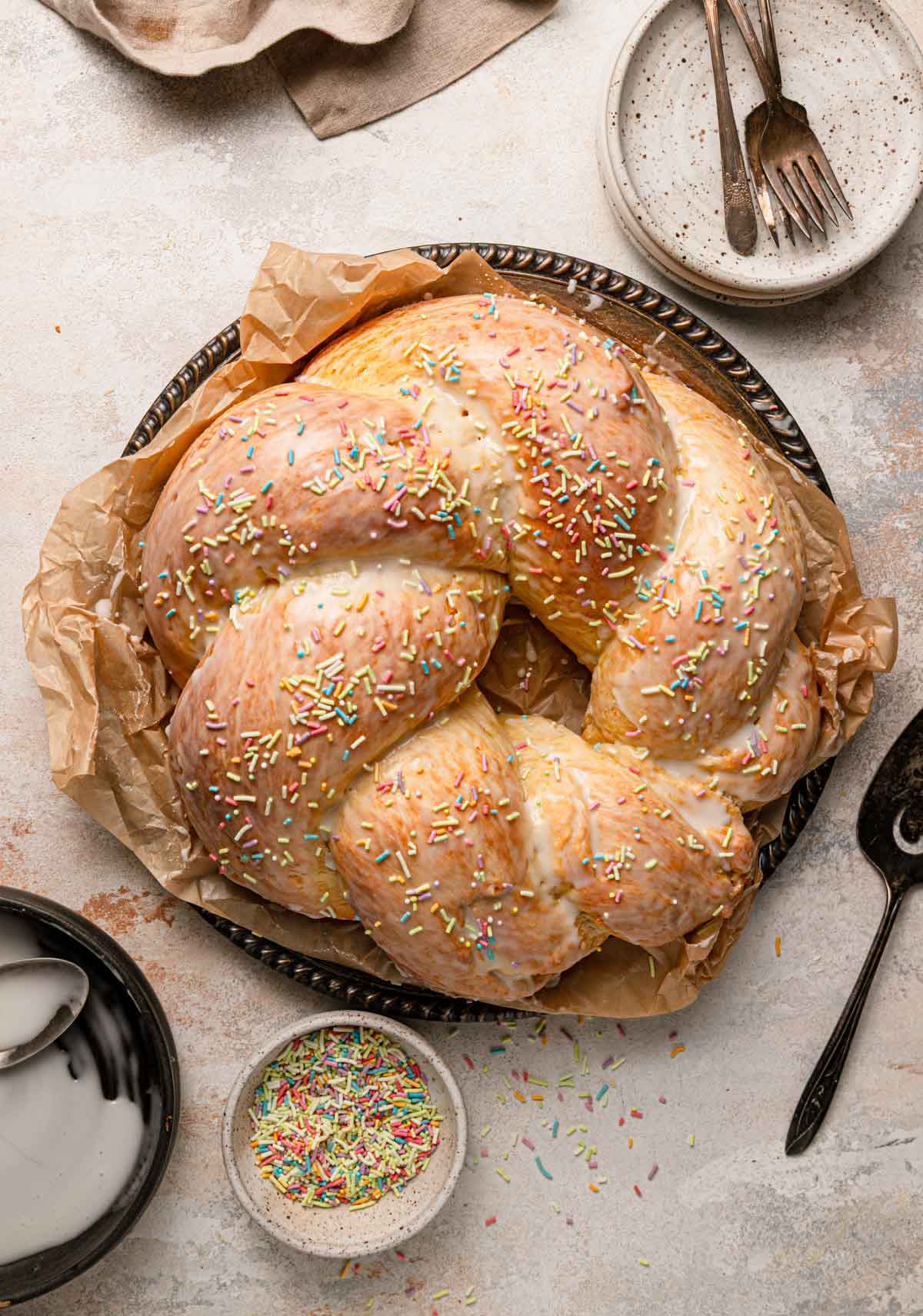
I did some reading up on Italian Easter Bread recipes before tackling this one, and from what I can tell, most all are flavored in some way with citrus (orange or lemon) and anise oil and/or anise seeds. Usually the loaves are braided and have colored Easter eggs nestled into the braids in various spots. I am not big into coloring Easter eggs, so I skipped that part, but went the traditional route with the braided loaves and sweet glaze.
This is a traditional 2-rise bread recipe. First the dough is mixed together, and left to rise until doubled…

Then it is shaped, and left to rise again before it is baked…

After hearing about the Italian Easter Bread, I had asked my mom if, in fact, my grandma had ever made anything like it, and she said she couldn’t remember her making something like that during Easter. Fast forward to my mom seeing and tasting the finished bread that I made. Aha! A light bulb! She said that my grandma did, indeed, make this exact bread, and even remembered that she would set eggs in the dough. However, my grandfather was the only one in the family that really enjoyed the bread, so when he passed away, my grandma stopped making it. I was only 5 years old at the time, so even if I had tried it at some point before then, I likely wouldn’t have remembered. I was bummed that I had never been introduced to it, but thrilled to know that it had been a part of my family’s traditions at some point, and that it was something my grandpap loved.

For a true bit of nostaglia, below is the original handwritten recipe (half in English, half in Italian, as far as I can tell) from my Chief Culinary Consultant’s great-grandmother. I just love seeing things like that!

Stay tuned tomorrow – I will be sharing another Easter bread recipe, this one from my grandma, and it’s a savory version. I think you’re going to loooove it!
In the meantime, buy some oranges – you’re going to want this traditional Italian Easter Bread on your table come Sunday!

One year ago: Lemon Poppy Seed Muffins
Two years ago: Easter Egg Sugar Cookies
Four years ago: Gooey Chocolate Cakes
Nana Latona's Italian Easter Bread Recipe
Yield: 2 huge loaves or 4 medium-sized loaves
Prep Time: 2½ hours
Cook Time: 35 minutes
Total Time: 3 hours 10 minutes
Ingredients:
For the Bread Dough:
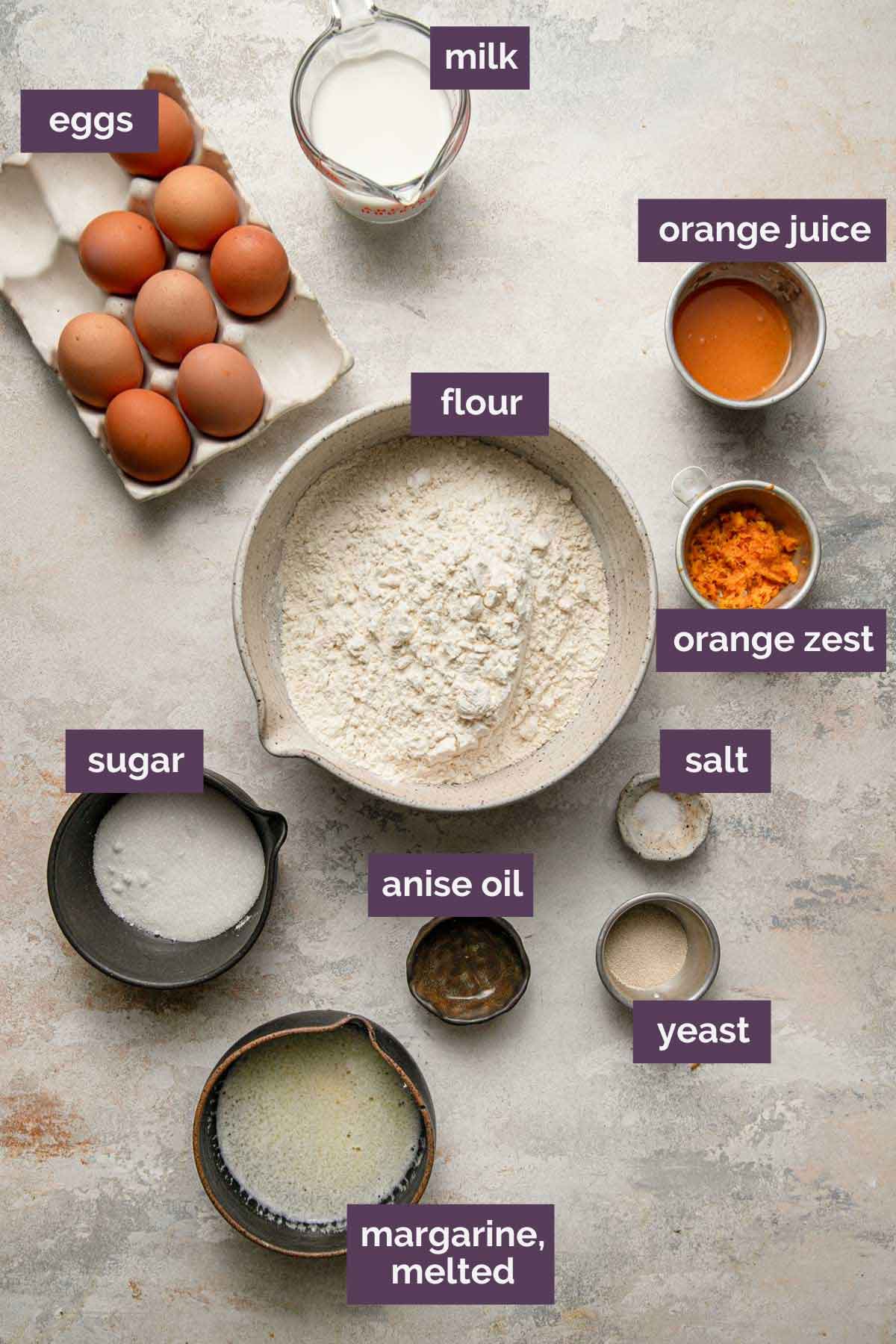
8 cups all-purpose flour
1½ cups whole milk
½ cup granulated sugar
2 oranges, zested & juiced
4½ teaspoons (2 envelopes) active dry yeast
1 cup margarine, melted
8 eggs
1 teaspoon salt
½ teaspoon anise oilFor the Glaze:
2 cups powdered sugar
¼ cup whole milk
Sprinkles, if desiredDirections:
1. Place the flour in a large mixing bowl; set aside.
2. Heat the milk in a small saucepan over low heat, stirring occasionally, until it is warm to the touch, but not hot. If you have an instant-read thermometer, the temperature of the milk should be between 110 and 115 degrees F.
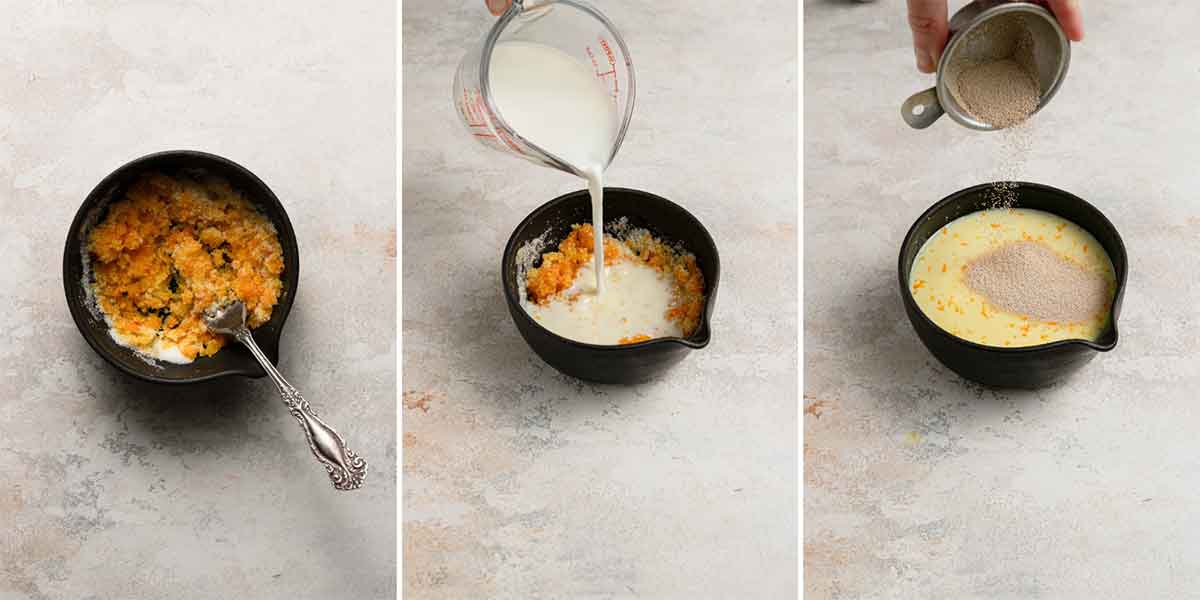
3. While the heat is warming, place the sugar in a small bowl and add the orange zest. With your fingertips, rub the zest into the sugar until it is completely incorporated and the sugar is moistened.
4. Once the milk reaches the correct temperature, stir in the sugar and zest mixture, stirring to dissolve the sugar. Add the yeast, stir, and let sit for 10 minutes.
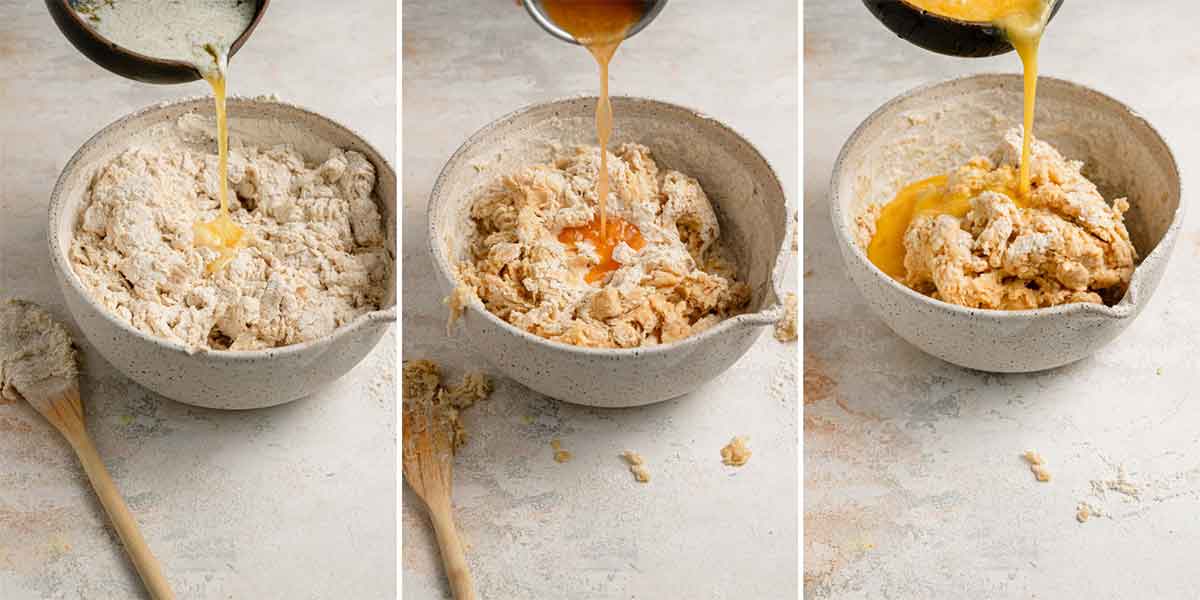
5. Add the milk and yeast mixture to the flour and begin to mix it into a dough (it will be shaggy at this point).
6. Next, add the melted margarine and continue to mix. Now, add the orange juice to the dough and mix to combine.
7. In a small bowl, use a fork to lightly beat together the eggs, salt, and anise oil. Add to the dough and continue mixing.
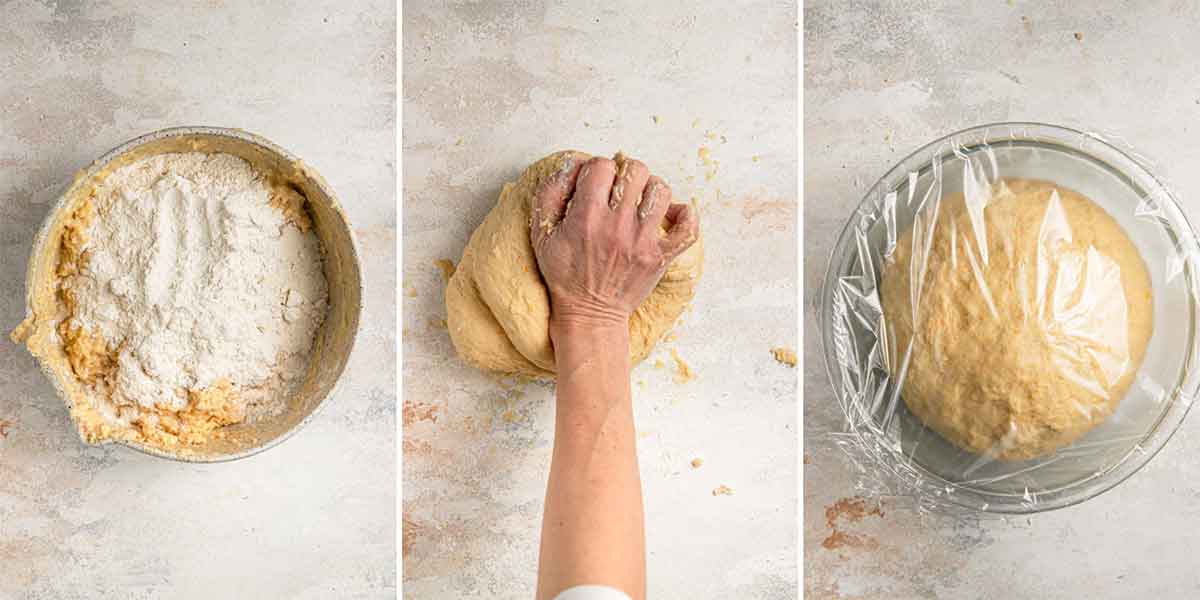
8. At this point, you may need to add more flour to the dough, depending on how much juice you get out of your oranges. I added quite a bit more to get the dough to come together. Once you have a sticky ball of dough formed, turn it out onto a floured surface and knead for about 5 minutes, or until the dough is soft and elastic. It will remain slightly tacky.
9. Place the dough in an oiled bowl, turning to coat, and cover the bowl loosely with plastic wrap. Place in a draft-free area and allow to rise until doubled in volume, about 1 hour. Meanwhile, line two baking sheets with parchment paper and set aside.
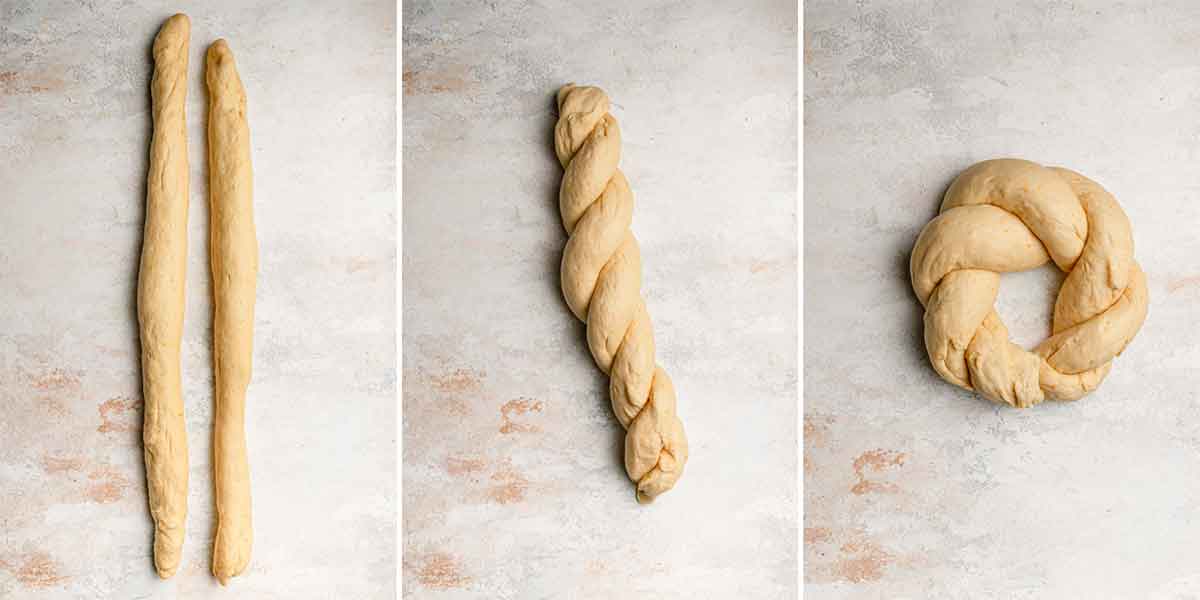
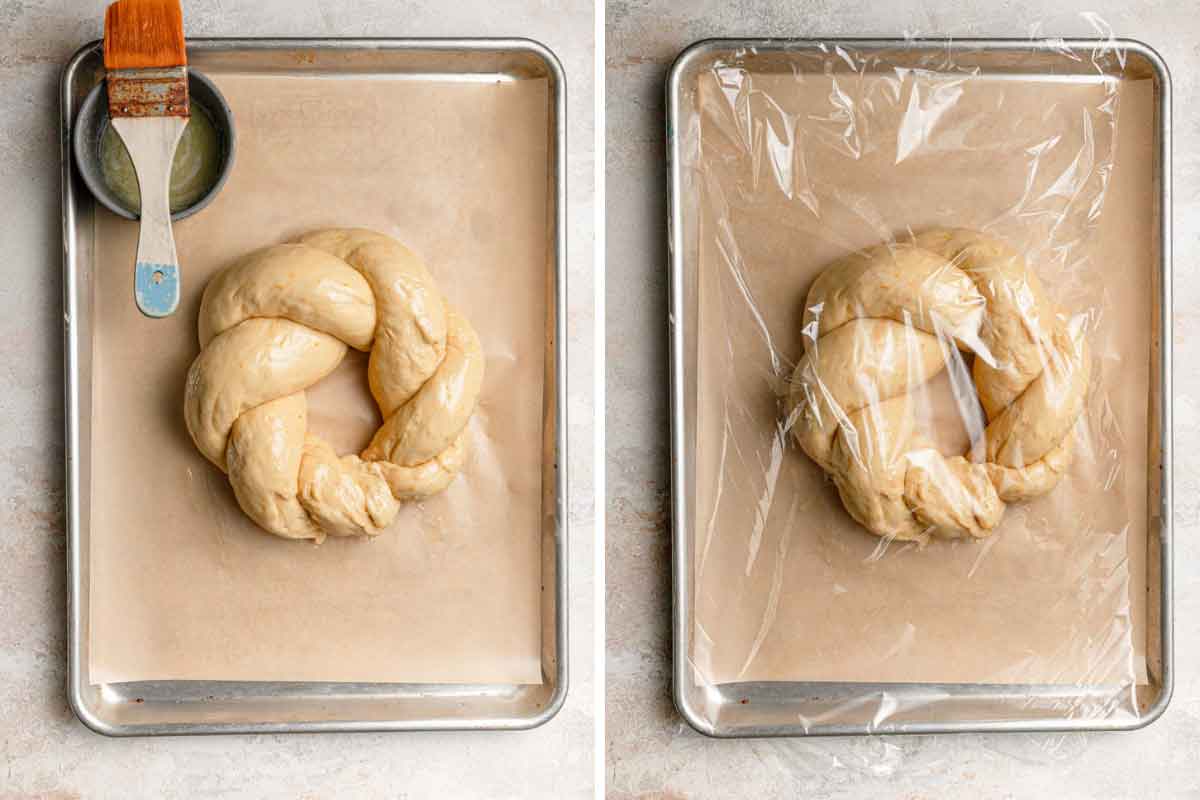
10. Turn the dough out onto a clean surface and divide in two. Divide each half into two (you will have four pieces of dough). We will work with one pair, and then the other. Roll two pieces of dough into 24-inch long ropes. Loosely twist the ropes together. Transfer the braided rope to one of the prepared baking sheets and bring the ends together to form a ring, twisting and pinching the ends together to seal. Repeat with the remaining two pieces of dough so that you have two circular, braided loaves. Brush the tops of each with melted butter, loosely cover with plastic wrap, and let rise until nearly doubled in size, about 45 minutes to 1 hour.
11. While the dough is rising, preheat the oven to 350 degrees F. Bake one at a time (unless you have the oven capacity to correctly bake both at the same time) until golden brown on top, 30 to 40 minutes. Remove from the oven and transfer to a cooling rack to cool completely.
12. Once the breads are cooled to room temperature, you can glaze them (if you desire). Whisk together the powdered sugar and the milk, adding more if necessary to reach the desired consistency. Use a pastry brush to brush the glaze onto the top and sides of the bread, and decorate with sprinkles. The bread is best served at room temperature. If you have leftovers, wrap well in plastic wrap and store at room temperature for up to 3 days.


The tiny sprinkles on this bread make me happy. How cool to see the recipe in your Nana’s handwritting.
Reply
What a gorgeous Easter bread. I love the addition of the orange zest, and the sprinkles make it absolutely darling.
Reply
My husband’s two favorite things on the planet: brioche and sprinkles. I think you just hit jackpot.
Reply
That looks like a great recipe and it’s so amazing your grandfather used to love it
Reply
Aaaaw, thanks for sharing! This looks so yummy and so easterly – must make it for my boyfriend and see if he knows it (he’s Italian). I am really curious how the anise will turn out.
Reply
This sounds delicious. I love the way her recipe is written in both italian and english!
I have a lot of really old recipes completely in italian.
Reply
SO pretty!
Reply
What a special recipe! Looks like the best Easter bread recipe I have seen yet…
Reply
Looks so light and fluffy! I’ve never seen sprinkles on bread, very cute.
Reply
Oh, I can not wait to try this. My german grandma always put dried fruit in ours which is definitely a taste to acquire. I think I could get little one to try this version–never used anise oil before. Is it a strong taste?
Reply
Michelle on April 4th, 2012 at 1:54 pm
Hi Kris, In some recipes, yes, anise can be strong, but in this particular bread recipe it is much more subtle. The orange is the prominent flavor here, and the anise merely accents it and gives it a little more depth.
Reply
Gina on April 4th, 2012 at 6:56 pm
Can we substitute extract for the oil? Would there be any modifications?
Reply
Lyle on April 6th, 2012 at 11:43 am
Gina
The conversion from Oil to extract is 4 to one so use 2 tsp of extract to substitute for 1/2 tsp of oil.
Reply
Michelle on April 6th, 2012 at 7:57 pm
Thank you, Lyle! Gina – this was going to be my recommendation.
Reply
seeing her recipe, brought a tear to my eye…i have a few slips of paper like that from my nana too. in fact, this year the sweet easter bread is on my to-do list too!
Reply
Gorgeous bread! I think I’ll make this on Friday! I love the sprinkles you put on it!
Reply
This is so pretty! Awesome idea!!
Reply
This sounds so good. Just one question…I have a bag of instant yeast from king Arthur & I never know if I can use the instant yeast in place of others. Should I use the same amount of instant vs active dry?
Reply
Laura on April 4th, 2012 at 7:41 am
I actually just found the answer to my own question!! It’s equal conversion & there is about 2 1/4 tsp of yeast in one packet. Thanks for th great recipes
Reply
I might just make this. My MIL who is from Italy will be joining us for Easter dinner. I am sure she would love to go home with this bread and enjoy it with her tea. Thanks to your CCC’s dad for sharing and for you for baking it up for the rest of us to enjoy.
Reply
The photos of your dough rising are beautiful and the cooked bread is awesome! Wonderful job on the braiding!
Reply
The bread is just lovely, and I love all breads flavored with citrus, but the best part of this whole post is the original handwritten recipe. I absolutely adore things like that!
Reply
Growing up, there was a sweet little old Italian lady that lived two doors down. I looked forward to her Easter treat tray each year, complete with a version of this. (I am thinking it was more like a cookie than a slice of bread) I adored the glaze and the sprinkles! I wish my childhood self would’ve known to think to ask her to teach me a thing or two!
Thanks for sharing this recipe, your memories, and for my own childhood memory trigger!
Happy Easter!
Reply
That bread is so beautiful! And it sounds delicious. I absolutely love the hand written recipe. So cool! I have an old cookbook of my grandma’s and I have kept all the little scraps of paper she had written recipes on. But none of hers were bilingual!
Reply
I can’t wait to try this for Sunday. I think my Italian husband will love it!
Reply
My future mother-in-law makes delicious Easter Bread! I have a couple loaves in the freezer waiting for this weekend
Reply
Thank you for this recipe, Michelle. It looks very similar to one my grandmother used to make when I was a child (many moons ago). It is one I will try, although I’m not perfect yet with yeast recipes.
Reply
Beautiful!
Reply
Looks so gorgeous!!
Reply
What a gorgeous looking bread, sounds delicious flavouring it with orange!
Reply
I have been making Easter Egg Bread for as long as I have been baking. This and Anisette cookies (Yes I am Italian) are the first things that I mastered on my own at age 12 or so. My Easter bread though sometimes comes out a little dry. I compared your recipe to mine and they are very different. My recipe uses anisette and lemon, cream instead of milk….I’m going to try yours this year. I really don’t care to add more colored eggs to the day so I usually leave them off too. Sprinkles were a nice idea to make it pretty!
Reply
PS—-
In my house, no Easter is complete without “easter pizza” (also known as pizza rustica). I can post the recipe of you like.
Reply
Michelle on April 4th, 2012 at 1:58 pm
Hi Dorothy, My grandma also had an Easter “pizza” recipe, which is really a savory bread. I’ll be sharing it tomorrow, but I always welcome new recipes! Feel free to send it my way!
Reply
Looks amazing, and what a great story behind it. Sometimes being in the kitchen is about so much more than just the baking and cooking.
Reply
This recipe looks amazing! I am definitely going to make this on Sunday.Thanks!
Reply
This bread looks wonderful, I will have to try it
would this be served with the dinner or dessert? Thanks for sharing!!
Reply
Michelle on April 4th, 2012 at 1:58 pm
Hi Melanie, You could serve it either way. I’ve eaten it for breakfast, alongside a meal, as a snack, as dessert. It’s very versatile
Reply
This is way too much bread for a person living alone. Can I half this?
Reply
Michelle on April 4th, 2012 at 1:59 pm
I have not done so, but I think you should be able to.
Reply
Sprinkles, on bread, I’m SOLD!
But I also really like reading the story behind the bread
Reply
Beautiful bread and I love the note from your nana. I would like to know if I could half this recipe? Thank you!
Reply
Michelle on April 4th, 2012 at 1:59 pm
Hi Almira, I think you should be able to halve this without an issue. Enjoy!
Reply
One of the winners in the CA Raisin Bread contest for 2011 had a recipe very, very similar. Of course she included raisins. It looks almost identical. I’ve got to try it. Everyone loved it.
Reply
This is extremely similar to my Mennonite Grandma’s Paska recipe. It’s quite a simple recipe but it is essential for Easter! The recipe calls for half an orange and half a lemon blended in a food processor. We top ours with an easy milk, icing sugar, almond flavouring icing and then load it with sprinkles. It’s shocking how similar the recipes are! Mind you, Mennonites are from all over Europe, it should be no surprise they collected ideas from many different cultures.
Reply
Do you think it would be ok if I made this today & froze it until Easter morning? I was thinking I could re-heat it a little after its defrosted & then glaze it. Just wanted another opinion. Happy Easter!!!!
Reply
Michelle on April 4th, 2012 at 5:21 pm
Hi Laura, Yes, you could definitely do that. I would wrap it well in plastic wrap, then in foil. Enjoy!
Reply
How lovely that you are reintroducing a family tradition and what a lovely recipe you’ve chosen – this bread looks stunning – glad you’ve left out the eggs – this addition always seemed a little strange to me!
Reply
Beautiful bread. Here we call it Rosca de Pascua (Easter Round) and usually has hard boiled eggs sitting on top of it but never aniseed. Do you think anise seeds will work the same way as anise oil? I´m always hesitant to use it, since it´s a very strong flavor.
Reply
Michelle on April 4th, 2012 at 5:22 pm
Hi Paula, The recipe does say that you can add anise seed if you wish. If you are leery of a strong flavor, I would probably use one or the other, not both.
Reply
It’s beautiful, Michelle! How nice to have a legit handwritten recipe!
Reply
The copy of the handwritten recipe brought tears to my eyes. It looks exactly like my Mom’s handwriting. I understood each of the ingredients and directions as written. We are adding this to our Easter celebration.
Buona Pasqua!
Reply
I made this tonight and omitted the anise oil because I couldn’t find it at my local store. I halved the recipe and made 2 medium size loafs. My dough didn’t rise too much, but they turned about amazing! Thanks for the recipe! Happy Easter!
Reply
Wow! This bread looks so delicious. Happy Easter!
Reply
This looks like a nice alternative to my original favorite Easter bread: hot cross buns. I’d love to try this, but I’d have to halve it… I’m lazy and I need it to fit in my Kitchen Aid mixer.
Reply
We always have this on Easter! Right along with homemade ravioli & Italian wedding soup. I love Italian holiday meals.
Reply
Very pretty! I’d love to try this with the dyed eggs stuffed inside.
Reply
I’m definitely going to make this bread. Since I live in California, I like recipes where I can use oranges from my trees. I grew up living in my Italian immigrant grandparents’ home in the Homewood section of Pittsburgh. My grandma made an Easter recipe using the colored eggs, but my mom and I remember it tasting like a cookie dough and not a bread. Has anyone heard of that? She shaped the dough like an Easter basket and put a colored egg in it.
Reply
Gorgeous bread, Michelle! I love recipes with tradition behind them. Hope you have a wonderful Easter!!
Reply
I made this yesterday and we had it for breakfast this morning. It looks gorgeous and tastes completely delicious. Unless you’re feeding an Italian family on Easter morning or bringing a whole loaf to church though, I’d definitely halve the recipe. It makes a LOT of bread. Also, I had to go to my local cake and candy supply shop to get the anise oil since the grocery store didn’t have it. Even my husband, who didn’t grow up eating my nonnie’s anise biscotti, agreed that it’s a subtle flavor so the amount of anise oil is probably good for most people. I’m thinking about maybe making french toast with it Easter morning, but I’m a bit stumped as to the kind of syrup to serve. Orange seems like overkill…
Reply
so easy and wonderful! My dough didn’t rise at first though- I ended up adding another packet (I halved the recipe also). I made two braided loaves instead of the ring and they came out wonderful! Thank you!
Reply
I am in the middle of making your bread and it says to add orange juice in the instructions, but there is no Orange juice listed in the ingredients! Help!
Reply
Melanie on April 7th, 2012 at 7:24 pm
The orange juice comes from the oranges you used the zest from
(2 oranges, zested & juiced)
Reply
Mike on April 7th, 2012 at 10:05 pm
2 oranges, zested & juiced
Reply
Michelle on April 9th, 2012 at 1:11 pm
Hi Corrie, The oranges in the recipe are to be zested and juiced; that is the orange juice you use.
Reply
can I put anise seeds in this as well, and if i do, do I have to omit some or all of the anise extract.
Reply
Michelle on April 9th, 2012 at 1:11 pm
Yes, you can! You don’t need to omit anything.
Reply
My bread didn’t rise at all. I followed the instructions step by step.. any idea what could of went wrong? My oranges did have a lot of juice so I had to add a decent amount of flour, could this be the cause?
Reply
Melanie on April 8th, 2012 at 3:02 pm
Maybe your yeast was bad, I must of had extra juice too because I had to add ALOT of flour to be able to work with it and my bread doubled in size. I did let it rise about an hour and half during the first rise becuase I got busy. So maybe check your yeast.
Reply
Michelle on April 9th, 2012 at 1:15 pm
Hi Melissa, I don’t think so; I also got a lot of juice from my oranges and added a ton more flour, and my dough swelled up. I am wondering if you used old yeast, or if perhaps your water was either too cool (yeast didn’t activate) or too hot (killed the yeast)?
Reply
Thanks so much for posting this! I made it for my family for our Easter dinner and it was a big hit (I’ve been told that I WILL be making it again…soon). I love that your site continually challenges me to try all these different recipes that are so delicious, I simply can not resist
Reply
I halved this recipe and it was perfect. The bread is deliciously orangy buttery rich and sweet. The icing is the literally the icing on the cake!!! It would not be the same without it. It adds a lil sweetness to the bread which accompanies it nicely. It was the first time I’ve ever made bread and it came out great so it shouldn’t b considered too hard.it was loads of fun seeing how the dough doubled and twisting the dough into braids as we’ll as icing and decorating it w the sprinkles and colored eggs!! I will prob make this bread every Easter.
My family loved it and everyone commented how good it was and u could tell they really enjoyed it!!!
Reply
Thank you SO much for sharing this recipe. This was a total hit (I didn’t have anise oil, so I substituted vanilla extract). The children helped with the glaze and sprinkles. Everyone devoured the bread plain and then someone pulled out the nutella. Talk about gilding the lily. Next time I might try saffron with the milk (and skip the anise again).
Reply
I made this! It was amazing. Thank you for sharing. I used Poppy seeds instead of sprinkles. Delicious.
Reply
I made this on Holy Saturday to enjoy Easter morning. It was wonderful. I was happy it made 4 breads, because they were excellent Easter gifts . This does make a lot of dough, and when it comes to kneading I got a little lazy. I cut the dough in half, & put it in my Kitchen Aid mixer for 5 min. Took it out and did the same with the other half of dough. Then I quickly kneaded the two halfs together by hand. This allowed me to get the right texture in the bread without breaking a sweat! I will be making this bread every Easter
Reply
Loved the Easter Bread! I made it Saturday, and it was FABULOUS!!!!
Looking for the recipe for Easter Pizza Rustica by Dorothy!
Reply
Made the italian easter bread this weekend. This morning it is a huge hit at my workplace. It even brought a few nostalgic moments for someone whose grandfather used to make rolls with Anise oil in them – she wandered in and asked if they had anise in them and was delighted when I confirmed her suspicions. As always thanks for sharing your recipes!
Reply
I love seeing handed-down recipes stay alive through tradition! This sounds absolutely amazing =)
Reply
Can we freeze the dough for a day or two before shaping and baking them?
Reply
Michelle on May 1st, 2012 at 12:22 am
Hi Li-Anne, I’ve never frozen this dough. I would probably be more apt to make the bread and then wrap it tightly and freeze until you want to serve it. Thaw at room temperature.
Reply
Gorgeous bread! Can we substitute the margarine with oil or butter? How much should we use? Thank you
Reply
Michelle on June 5th, 2012 at 9:57 am
Hi Joyce, I would use the butter as a substitute. Enjoy the bread!
Reply
Annette Litteral on October 31st, 2012 at 9:44 pm
Hello,
I was looking for the Italian Easter Bread recipe but did’nt see it, I have one from my mom that I wanted to compare it to. The pictures look very similar to what she made, I don’t think it was braided though. I tried to make hers and the dough was too sticky to knead, wanted to try yours if you could post recipe. thanks Annette
Reply
Michelle on November 1st, 2012 at 1:50 pm
Hi Annette, It looks like there was a glitch from the site redesign, but the recipe is up there now. Enjoy!
Reply
The most beautiful dough that I have seen on a long time .My moms recipe is almost the same a little less flour. I made yours today it ess amazing the smell in my house was intoxicating.. Thank you so much for sharing this beautiful traditional recipe with us … Buona Pasqua!!!!
Reply
Hi Michele, I look forward to trying this recipe. My Nana would place colored hard boiled eggs into the braided dough. Could I do that with this recipe?
Reply
Michelle on March 11th, 2013 at 8:53 pm
Hi Ria, Absolutely!
Reply
Hi Michelle, I made this yesterday, one for myself and another one to give away. It is simply fantastic, I definitely suggest you put the icing on. Thank you for another delicious recipe!!!
Reply
I have a question…the recipe calls for 1 cup of margarine. Why not butter? I never cook or eat margarine. I will if it makes a BIG difference, tho.
Reply
Michelle on March 28th, 2013 at 2:20 pm
Hi Jean, I never, ever use margarine either, but there are a handful of old family recipes that call for it, so I use it in those. It does have different properties than butter, so I stick with the margarine.
Reply
Hi, this bread looks delicious!! Do you think it is possible to mix the dough in a bread machine? (and bake in the oven) Would the assembly change at all?
Reply
I made this but had difficulty rolling the dough into logs, as the dough was really elastic; when I rolled out the logs into a desired length they wold shrink back. This made it difficult to wrap the dough around each other and created a rather lopsided loaf. Any suggestions?
Reply
Michelle on March 30th, 2013 at 5:21 pm
Sometimes yeast dough can do the shrinkage thing. The best thing to do is cover it with a damp towel and let rest for 10 minutes or so, and then try again.
Reply
It is so sweet to see the recipe half Italian, half English! My Mom does the same thing! The only difference from my mom’s recipe who is from Italy, Frosinone area (Ceccano) south of Rome, is that she adds uncooked colored eggs in between the rope twists. Continue with the recipe as is and eggs will obviously bake (cook) when you bake the bread. It looks so beautiful when done!
Reply
Marsa D'Emilio Manthey on March 29th, 2013 at 11:11 am
Go to this site to see a picture!
http://www.google.com/imgres?imgurl=http://www.explore-italian-culture.com/images/italian-easter-bread.jpg&imgrefurl=http://www.explore-italian-culture.com/italian-easter-bread-recipe.html&h=247&w=400&sz=17&tbnid=His6BQk27XHBaM:&tbnh=90&tbnw=146&zoom=1&usg=__d90UoHIgaiTV2RxxLek1-y2Qc-k=&docid=8uT3mUXWCEBJ6M&hl=en&sa=X&ei=dalVUeuAIMXG0gH8iYCoDw&ved=0CEkQ9QEwAw&dur=6925
Reply
Marsa D'Emilio Manthey on March 29th, 2013 at 11:12 am
If above doesn’t work…go here to see pic
http://www.explore-italian-culture.com/images/italian-easter-bread.jpg
Reply
I also loved finding this recipe because it was just like my husband’s Italian grandmother’s recipe, although she used anise seeds in her recipe. I loved you have the recipe written in your great grands handwriting. The loaves are in the oven and smell delicious.
Reply
ok really stupid question I want to make 4 smaller loaves, It says bake one at a time for 35 mins do I leave the other loaves out on the counter while I bake one at a time?
Reply
Michelle on March 30th, 2013 at 5:24 pm
Christie, If you are making smaller loaves and can fit them all on one sheet, then you can bake them at one time.
Reply
Hello, I like this bread! Mine are going in the oven in about 10 minutes I guess.. I am curious how they will turn out. Question: Why so many eggs? While mixing the eggs it looks like the dough drowned in them. So I added more flower to make it less sticky. (I made half of the recipe just to try maybe tomorrow another half of the recipe) I made 3 bread one larger and 2 smaller out the half of the recipe.
Reply
forgive me but when I translate the Italian handwritten recipe I see that it is not exactly translated into the english version. Can you verify this. What I was looking for is an Italian Easter bread recipe similar to the handwritten one cause it is made with shortening.
Reply
Michelle on April 2nd, 2013 at 11:38 am
Mary, This is my fiance’s family’s recipe, and from what I understand, it has been made the same way for decades. If you prefer shortening, you could try using that in place of the margarine, but I can’t guarantee how the bread will turn out.
Reply
Mary on April 2nd, 2013 at 4:39 pm
Hi Michelle, Just based on how I’m reading the italian hand written version , it clearly states “crisco” . This is why I was asking. My grandmother also made Easter bread with crisco, unfortunately nobody got the recipe right before she passed. This is why I was so excited when I saw that in Italian. I was disappointed it wasn’t translated to english exactly as it read in Italian.
Is it possible for you to translate it as it reads, unfortunately I’m not able to make out each word.
Thank You
Reply
Michelle on April 3rd, 2013 at 9:46 am
Hi Mary, Unfortunately I cannot translate it because I do not read or speak Italian. The only thing I have to go on is how my fiancé’s family translated it. It does look like the recipe reads Crisco or Oleo, which is what some folks used to refer to margarine, which is what his family uses in the recipe. I think you would be fine using the Crisco if you prefer.
Reply
I made this recipe earlier this week and it was fantastic! Everything went great, and the bread came out perfectly; I am definitely keeping this recipe to use again later.
I made a small modification though. I did not have any anise essence/oil/extract, however I did have some star anise lying about that was only a couple of months old. The afternoon before I made the bread, I measured out the milk I would need and I soaked two whole pods in the milk for 24 hours. The milk had a lovely hint of anise to it, and it worked swimmingly! I would recommend this to anyone who can’t find anise oil anywhere, as it might be tricky if you don’t have a health food store handy
Reply